Plant nutrition · Care note 007
Feed the growth you can verify.
Winter is not a fertilizer setting. Check the identified plant, active growth, available light, root zone, existing nutrients and product label before adding another input.
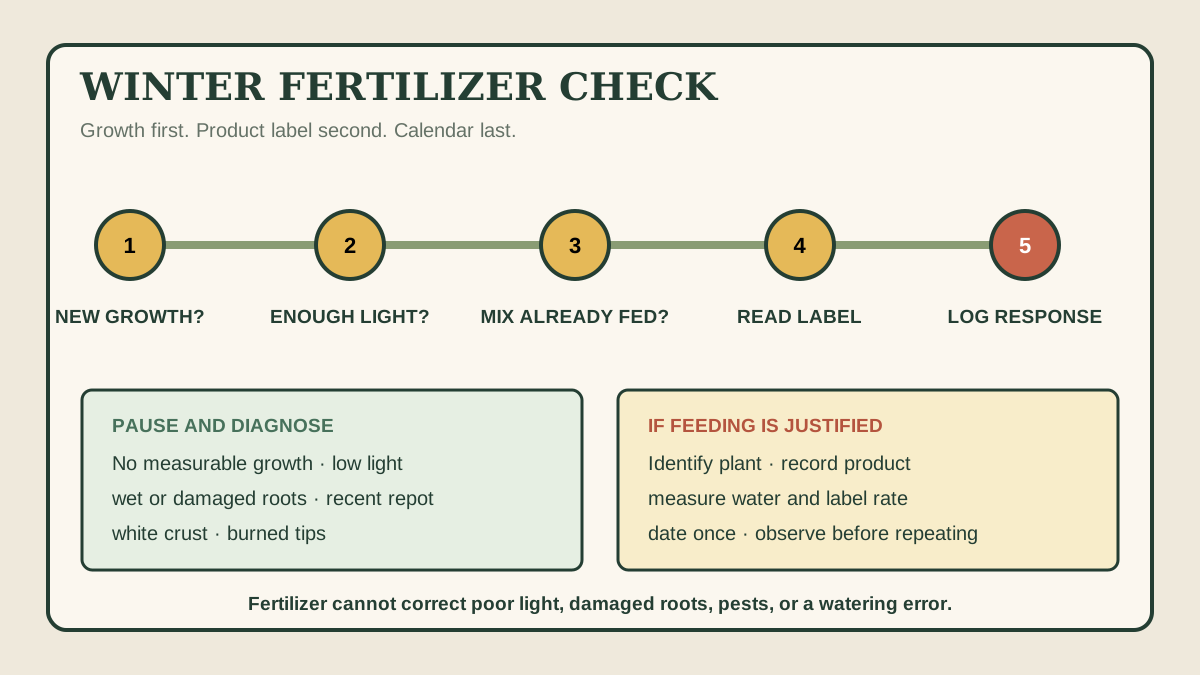
“Stop fertilizing in winter” is useful shorthand for many windowsill houseplants, but the reason matters. Iowa State University Extension says fertilizer is generally unnecessary in winter because most houseplants are not growing then. Its broader care guidance refines the rule: fertilize only when houseplants are actively growing, reduce fertilizer during periods of rest, and remember that newly repotted plants may already receive fertilizer from the potting mix.
That creates a better question than “Is it November?” Ask whether this particular plant, in this room, under this light, with this root system and potting medium, is actively producing growth that its current system can support. A calendar cannot answer that. A plant record can.
Start with active growth, not one pale leaf
Look for measurable change across several check dates: a new leaf expanding, a stem extending, roots developing in a transparent pot, or buds progressing on a species expected to grow or flower now. Compare photos taken from the same angle and record dates. A single folded leaf may have started weeks earlier; one yellow lower leaf may be normal aging rather than a request for fertilizer.
Species and growing system matter. Some plants slow under short natural days. Others continue under suitable grow lights and stable indoor temperatures. Certain plants have species-specific rest or flowering cycles. Use current Extension or botanical-garden guidance for the identified plant rather than applying a collection-wide winter schedule.
| Observation | What it can tell you | What it cannot prove |
|---|---|---|
| New leaf or stem growth | The plant is active | That nutrients are deficient |
| Growth has slowed | The system changed | That fertilizer is the missing input |
| Older leaf yellowing | A symptom needs context | That nitrogen is required |
| Pale, stretched growth | Light and growth balance need review | That a stronger feed will help |
| Flowers or buds | The plant is in a reproductive phase | That a “bloom booster” claim fits the species |
Iowa State cautions that more fertilizer can drive more growth when indoor light, humidity or moisture cannot support it, producing weak or spindly growth. Match any nutrient decision to the actual light at leaf level. The site's measured grow-light guide shows how to map fixture coverage, distance, timing and a dark period.
Rule out the limits fertilizer cannot solve
Before feeding, inspect the whole growing system. Poor light, chronic wetness, a dry hydrophobic root ball, blocked drainage, cold drafts, hot vents, pests, damaged roots and recent environmental changes can all slow growth or discolor leaves. Adding fertilizer to a stressed root zone can increase dissolved salts without correcting the cause.
- Identify the plant. Get as close as practical to genus, species or cultivar so the growth cycle and sensitivity are not guessed.
- Check light. Record window direction, obstruction, distance, grow-light setup and recent seasonal change.
- Check moisture at root depth. Do not infer the whole pot from a dry surface. Use the winter watering check.
- Inspect drainage and roots. Look for blocked holes, standing water, odor, unstable medium or root damage. Use the repot-or-wait checklist when crowding is suspected.
- Inspect for pests. Check leaf undersides, stems, crowns and the medium. If small flies are present, use the fungus gnat control plan.
- Review recent changes. A move indoors, new lamp, repot, treatment, pruning or temperature shift can explain the timing.
Do not use fertilizer as a diagnostic test. “I fed it and nothing changed” adds little information because roots, water and light control whether nutrients can be used. Change the most strongly supported factor first and keep the rest of the care stable enough to read the response.
Inventory nutrients already in the pot
Many commercial potting mixes contain starter fertilizer or controlled-release fertilizer. The bag should state whether fertilizer is included and may give a duration. A recently repotted plant can therefore have available nutrients even when no liquid fertilizer has been added. Iowa State notes that little or no additional fertilizer is typically needed for the first few months after repotting when the mix contains fertilizer.
Also check for controlled-release prills, fertilizer spikes, tablets, compost, worm castings, liquid feeds, foliar products or “plant food” added by someone else. Record the exact product and date. Marketing terms such as natural, organic, gentle or tonic do not mean the material contains no nutrients or salts. Read its guaranteed analysis, directions and intended use.
Do not stack products casually. A liquid fertilizer, amended potting mix and slow-release granule can overlap. The roots experience the combined dissolved materials, not separate brand stories. If the history is unknown, pause, identify visible inputs, and observe rather than adding another product to make the record more confusing.
Read six parts of the fertilizer label
If active growth, adequate light, healthy roots and species guidance support feeding, the product label defines the next decision. Do not copy an influencer's dilution across products: concentrations, nutrient analyses and application intervals differ.
1. Intended plants
Confirm the product is labeled for indoor container plants or the specific plant group.
2. Guaranteed analysis
Record the nutrient percentages rather than choosing from the front-label name alone.
3. Mixing rate
Measure both product and water with dedicated tools. Do not estimate from capfuls unless the label defines them.
4. Frequency
Follow the labeled interval and do not turn “with watering” into feeding every time without context.
5. Existing nutrients
Check whether the potting mix or a controlled-release product is already supplying fertilizer.
6. Safety and storage
Follow handling, protective equipment, cleanup, child and pet, temperature and disposal directions.
More is not a faster correction. University of Idaho Extension warns against overfertilizing and recommends decreasing or eliminating fertilizer during cooler, shorter winter days. University of Tennessee Extension notes that container media can accumulate salts because the root volume is small and fertilizer is often delivered as dissolved salts.
Never present a homemade additive as nutritionally equivalent to a labeled fertilizer without analysis. Tea, coffee, banana water, aquarium water and kitchen scraps have variable composition and may change moisture, microbes, odor or pests. A measured decision requires a known product, intended use and documented rate.
Recognize possible salt buildup without diagnosing by sight alone
White or crusty deposits on the medium, pot rim or drainage holes can be a reason to review fertilizer and water history. Brown leaf tips or margins, wilting, damaged root tips and declining growth can also occur with excess soluble salts. University of New Hampshire and University of Idaho Extension materials describe these patterns, while also noting that winter problems overlap with watering, humidity and other cultural conditions.
Do not scrape the crust away and immediately resume the same routine. Record the water source, every fertilizer and amendment, mix rates, watering volume, drainage, saucer practices and repot history. Inspect roots when justified and safe. Confirm that the pot drains freely.
Leaching advice depends on plant, medium, pot, water quality and root health. Do not repeatedly flood a cold, poorly lit or damaged root system. Use species-appropriate Extension guidance and the fertilizer and potting-medium labels. When damage is progressing or the cause is unclear, contact a local Extension diagnostic service with photos and the full care record.
Make one recorded change and wait for evidence
A useful feeding record turns a recurring guess into a controlled observation. Write the plant, pot, medium, light, product, guaranteed analysis, label rate, actual measured amount, water volume, date and reason for feeding. Photograph the plant before application and at consistent intervals.
| Field | Record |
|---|---|
| Growth evidence | Leaf, stem, root or bud change with dates |
| Light | Window or fixture, distance, hours and recent change |
| Existing fertilizer | Potting-mix charge, slow release and last applications |
| Product | Name, analysis, intended use and label rate |
| Application | Measured product, measured water, date and drainage |
| Response | Growth, color, moisture behavior and any damage |
Do not feed again simply because the next calendar reminder appears. Recheck growth, light, roots, moisture and the label interval. If the plant has stopped growing, the room darkened, or the medium stays wet longer, the decision may change.
Common winter questions
My plant is growing under lights. Can I feed it?
Active growth and adequate light make feeding more plausible, but do not complete the decision. Check species guidance, root health, medium, existing fertilizer and the product label. Record the application and response.
Will fertilizer fix yellow leaves?
Not reliably. Yellowing can involve water, light, temperature, roots, pests, aging or nutrition. Diagnose the system before adding nutrients.
Should I use half strength in winter?
Do not apply a universal fraction across products and plants. Start from the actual product label and authoritative guidance for the identified plant. If the label does not support your intended use, choose a suitable product or wait.
Can I fertilize right after repotting?
Check the potting-mix label. Many mixes already contain fertilizer, and Extension guidance says little or no additional fertilizer may be needed for the first few months. Root disturbance and species needs also matter.
Do organic fertilizers avoid salt problems?
No marketing category makes overapplication harmless. Read the analysis, directions and warnings. All nutrient sources must be matched to plant demand, medium, water and root conditions.
Sources and method
- Iowa State University Extension: Should houseplants be fertilized in winter?
- Iowa State University Extension: How to Care for Houseplants
- Penn State Extension: Bringing Plants Indoors for Winter
- University of Idaho Extension: Houseplants and Home Greenhouses
- University of New Hampshire Extension: Winter Houseplant Problems
- University of Tennessee Extension: Caring for Indoor Plants
Sources were reviewed November 3, 2026. Public discussions were used to identify recurring uncertainty about grow lights, new growth, reduced rates, recent repotting and salt buildup. Recommendations were checked against Extension sources and kept dependent on the identified plant and product label.