Indoor pests · Care note 005
Break the fungus gnat cycle
A yellow card full of adults can show where the problem is. It cannot reach eggs, larvae, or pupae in the pot. Use one month to confirm the insect, find every moist breeding site, correct the growing system, and measure whether the population is actually falling.
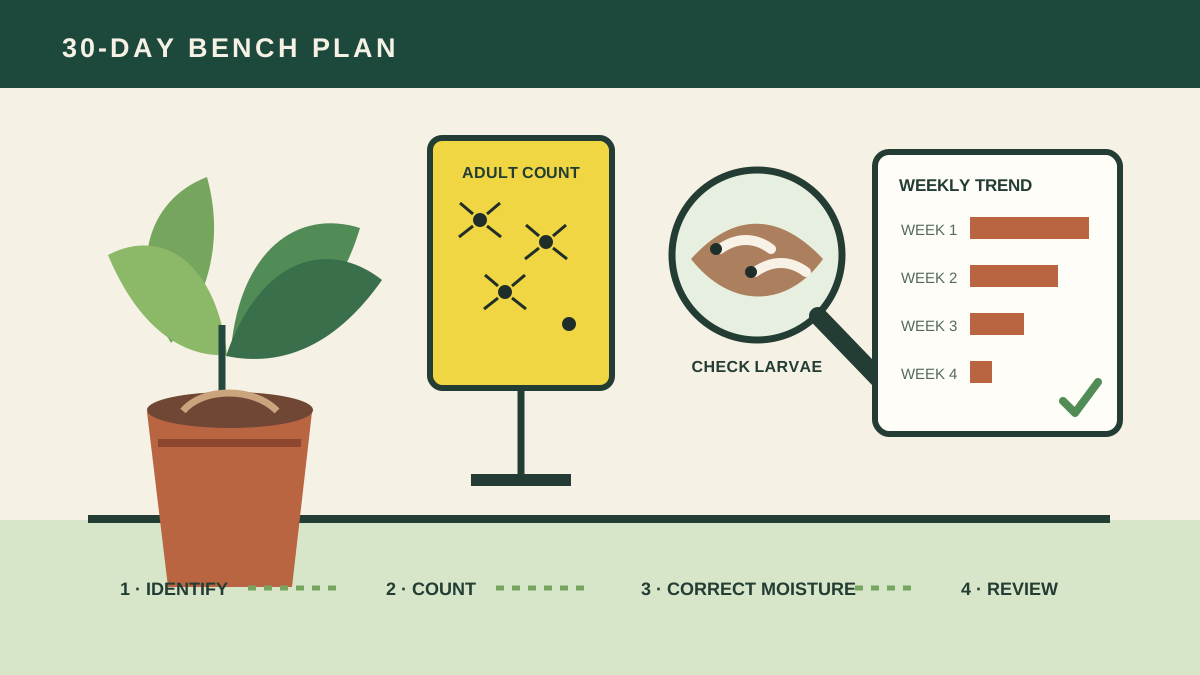
Fungus gnats create a misleading picture. The adults are visible around leaves, windows, lamps, and faces, so the first response often targets only the flyers. Most of the population is elsewhere. Eggs, translucent larvae with black head capsules, and pupae develop in damp organic material. When new adults emerge, it can look as though a sticky card, dry-down, or treatment did nothing even when the first adults were removed.
Colorado State University Extension reports that a fungus gnat generation commonly takes three to four weeks at typical room temperatures. UC Integrated Pest Management notes that generations overlap indoors. A useful control plan therefore lasts long enough to observe a full generation, separates adult monitoring from larval control, and records a trend rather than relying on memory.
Number a yellow sticky card for each suspect area, write the start date on the back, and count new adults on the same day each week. The cards become evidence: they show hot spots and whether the population is moving down, flat, or up.
Confirm fungus gnats before changing plant care
“Tiny black fly” is not an identification. Adult fungus gnats are delicate, mosquito-like flies, usually about 1/16 to 1/8 inch long, with long legs and antennae. Colorado State describes a Y-shaped vein near the tip of the wing. Adults tend to make short flights or run across the potting surface. They are often most noticeable after watering or when a pot is disturbed.
Fruit flies are usually stockier and gather near fermenting produce, recycling, or food residue. Drain flies look fuzzy or moth-like and rest near wet plumbing biofilm. Shore flies are stouter, have short antennae and may show pale spots on dark wings; they can breed in algae-rich greenhouse conditions. More than one small fly can occupy a home at once. Finding an adult near a plant is a clue, not proof that its larvae are in that pot.
Check the medium for larvae by gently disturbing the upper layer under bright light. UC IPM and Colorado State also describe using a slice or chunk of raw potato placed on the surface as a short-term monitoring lure; larvae may gather beneath it. Remove and discard the piece after inspection so it does not become decaying material in the pot. A hand lens helps reveal the clear-to-whitish body and dark head.
| Clue | Fungus gnat | Another source is more likely when |
|---|---|---|
| Shape | Slender, mosquito-like, long legs and antennae | Fly is fuzzy, broad-winged, or stocky |
| Activity | Short flights and running over moist medium | Activity centers on fruit, bottles, drains, or trash |
| Immature stage | Clear or pale larva with a black head in organic medium | No larvae are found after repeated checks of suspect pots |
| Pattern | Counts rise around persistently moist pots and propagation areas | Cards near plants stay quiet while another room is active |
Why sticky cards alone do not end the cycle
Adult fungus gnats live only a short time and do not cause the main plant injury. Their capture reduces egg laying and gives a useful count. The larvae are the feeding stage. They consume fungi, algae, and decaying organic material and can feed on fine roots. Seedlings, cuttings, and stressed plants have less root reserve and deserve closer attention than a vigorous, established specimen with a few adults nearby.
A card above the pot does not change saturated medium below it. Conversely, a larval treatment does not instantly remove adults that emerged before application. An integrated plan assigns each action a job: cards monitor and reduce adults; irrigation and drainage reduce suitable habitat; sanitation removes organic debris; a labeled biological or pesticide treatment, if needed, targets a stated life stage.
Late fall and winter are a common indoor peak. Colorado State explains the seasonal mechanism: light falls, plants use water more slowly, but people may continue the old watering interval. Plants recently returned from outdoors can also carry insects inside. The correction is not to dry every houseplant completely. It is to match moisture to the identified plant while avoiding a surface and root zone that remain needlessly wet.
Map every possible breeding site
One treated pot cannot solve an untreated source. Walk the collection from the highest card count outward and inspect anything that stays damp and contains organic matter.
- Every pot: note plant name, pot size, drainage holes, cachepot water, surface moisture, and how long the root zone stays wet.
- Propagation: inspect seedling trays, rooting media, moss poles, humidity boxes, and discarded leaves in water or mix.
- Stored media: close potting-mix bags and bins; inspect damp, opened material before using it.
- Decorative covers: lift nursery pots and empty hidden drainage water. Check damp basket liners and saucers.
- Plant debris: remove fallen leaves and dead roots from the surface without damaging healthy roots.
- Nearby wet sites: inspect drains or food areas separately if the insect identity is uncertain. Do not treat plumbing as a plant problem.
Quarantine new or returning plants long enough to inspect and monitor them before combining collections. The University of Minnesota Extension specifically recommends examining plants brought indoors and notes that fungus gnats favor moist soil. Isolation makes the source easier to see and keeps a small introduction from becoming a shelf-wide population.
Days 0–7: build the baseline and correct moisture
- Day 0: isolate confirmed or strongly suspect plants when space allows. Photograph the setup and record the number of adults already on each card.
- Check the root zone: use the plant’s documented moisture preference, not the presence of flies, to set a safe dry-down target. Read moisture below the surface and compare pot weight.
- Check drainage: confirm open holes, remove standing water, and note whether the potting mix is compacted, broken down, or staying wet far longer than its baseline.
- Reset the monitor: install a fresh, numbered yellow card near the medium without letting it touch leaves, pets, or people.
- Reduce debris: remove dead plant material and wipe the shelf. Clean tools before using them in another pot.
- Record irrigation: note the date, amount, method, drainage, and next check. A scheduled check is useful; a scheduled pour is not.
Allow the top one to two inches of medium to dry when that is compatible with the plant, its root system, and the pot. That range comes from Extension guidance for suppressing fungus gnat habitat, but it is not safe for every plant or every container depth. Moisture-sensitive ferns, young seedlings, and fresh cuttings may need a different strategy. Increase root-zone aeration and drainage without pushing the plant into drought stress.
Bottom watering does not guarantee control. Water can wick into the upper layer, and a dense medium can remain wet regardless of delivery direction. Use top or bottom watering according to the plant and container system, then verify where moisture remains. Do not leave the pot standing in water after the root ball has absorbed what it needs.
If treatment is needed, target the stated stage
UC IPM lists products based on Bacillus thuringiensis subspecies israelensis (Bti) and beneficial nematodes such as Steinernema feltiae among biological options used against larvae. Availability, registration, formulation, storage needs, application method, and permitted sites vary. A product name or active ingredient alone does not authorize a homemade recipe.
Read the current container label before buying or applying anything. The label must permit the target pest, indoor site, plant or growing medium, and intended method. Follow its exact rate, water volume, interval, protective equipment, storage, re-entry, disposal, and pet or child precautions. EPA describes the pesticide label as the controlling source for safe and effective use. If the label does not say that a product can be used for fungus gnats in an indoor houseplant system, choose another approach.
| Action | Main job | What it cannot prove |
|---|---|---|
| Yellow sticky card | Monitors and catches flying adults | That larvae are absent or the root zone is healthy |
| Moisture and drainage correction | Makes the medium less favorable and supports roots | That every existing larva died immediately |
| Sanitation | Removes debris and overlooked habitat | That the active pot source has been eliminated |
| Labeled Bti or nematode product | Targets larvae under its label conditions | That one application covers every generation |
| Repotting | Replaces failed medium when root or drainage evidence justifies it | That insects will not return to the same wet conditions |
Do not improvise concentrations of hydrogen peroxide, vinegar, essential oils, soap, cinnamon, or other internet remedies. A household product can injure roots, change medium chemistry, expose people or pets, and still miss the relevant stage. Evidence for one formulation or labeled use does not transfer automatically to another mixture.
Repot only when the medium has structurally failed, drainage cannot be corrected, roots need inspection, or another plant-care reason justifies the disturbance. Throwing away sound mix can stress the plant and spread insects around the workspace. If repotting is warranted, work cleanly, contain discarded medium, wash reusable containers, and start with properly stored material in a pot with working drainage.
Days 8–30: read the trend across a generation
Count cards on the same weekday and at roughly the same time. Replace a card when crowded, dusty, or no longer sticky, and write the final count before discarding it. Do not compare a card exposed for three days with one exposed for ten.
| Review | Record | Decision |
|---|---|---|
| Days 8–14 | Adult count, pots watered, moisture depth, new source found | Continue habitat correction; repeat treatment only if its label directs |
| Days 15–21 | Count trend by location, plant response, larvae under monitoring lure | Investigate untreated sources if counts are flat or moving rooms |
| Days 22–30 | Full-generation trend, last adult seen, root-zone condition | Keep monitoring; extend the plan if adults or larvae remain |
A brief rise after the first action can reflect adults emerging from pupae already present. A steady decline over comparable weeks is stronger evidence than one empty card. If counts plateau, verify the insect again, check hidden cachepot water and stored mix, confirm that every source received the same inspection, and review whether any treatment was stored or applied outside its label conditions.
Do not stop after a single quiet day. Overlapping stages mean a late adult can appear after an earlier group was caught. Continue cards for at least a full cycle after corrective work and keep the plant-care record. When counts stay at zero and the medium is drying in its healthy range, move from control to ordinary prevention.
Keep the fix in the growing system
The lasting improvement is a collection that can be observed. Use pots with accessible drainage, medium whose components and age are known, and cachepots that can be emptied. Store media dry and closed. Put new plants in a monitored transition area. Record changes in light because lower light changes water use.
Use the winter watering check to separate a recurring inspection from automatic irrigation. If a plant came from a patio or nursery, follow the indoor transition and quarantine sequence. When natural light falls, the measured grow-light guide helps document the environment rather than guessing from room brightness.
A future product brief for cards, media, biological controls, or monitoring tools should disclose dimensions, ingredients or active organism, storage, shelf life, permitted use, current registration, instructions, and supplier authorization. Green Leaf Depot does not publish checkout, price, branded inventory, or availability claims without verified commercial terms.
Questions from the plant bench
Why are there still adults after I put out sticky cards?
Cards do not reach developing stages in the medium. Keep counting adults while you correct habitat and, if necessary, use a larval control permitted by its current label.
How long should the plan take?
Expect to observe at least three to four weeks at typical room temperatures, then extend monitoring if catches continue. Temperature and conditions affect development, and overlapping generations blur a simple start and stop.
Will fungus gnats kill a mature houseplant?
Adults are mostly a nuisance. Larval root feeding is more concerning for seedlings, cuttings, stressed plants, and heavy infestations. Decline can also come from the persistently wet conditions that support gnats, so inspect roots and growing conditions rather than assigning every symptom to the insect.
Does a dry surface mean the pot is ready for water?
No. A deep container can be wet below a dry crust. Check at a useful root-zone depth and compare pot weight, drainage history, and the moisture needs of the identified plant.
Sources and label check
- Colorado State University Extension: Fungus Gnats as Houseplant and Indoor Pests — identification, biology, seasonal pattern, moisture management, and monitoring; peer reviewed and reviewed August 2025.
- University of California Integrated Pest Management: Fungus Gnats — life stages, cultural control, monitoring, biological controls, and treatment limits.
- University of Minnesota Extension: Bringing Houseplants in for Winter — inspection, isolation, watering, and indoor pesticide-use context; updated September 10, 2026.
- U.S. Environmental Protection Agency: Introduction to Pesticide Labels — how to read and follow the legally enforceable product directions.
Sources were reviewed October 20, 2026. Product labels and registrations can change; the current label on the container controls. Local Extension or a plant diagnostic clinic can help confirm insects or investigate plant decline.