Indoor watering · Care note 004
Use a check day, not a pour day
A weekly reminder can keep plants from being forgotten. It should start an inspection, not automatic watering. In winter, read the plant, root zone, pot, medium, light and room before you reach for the can.
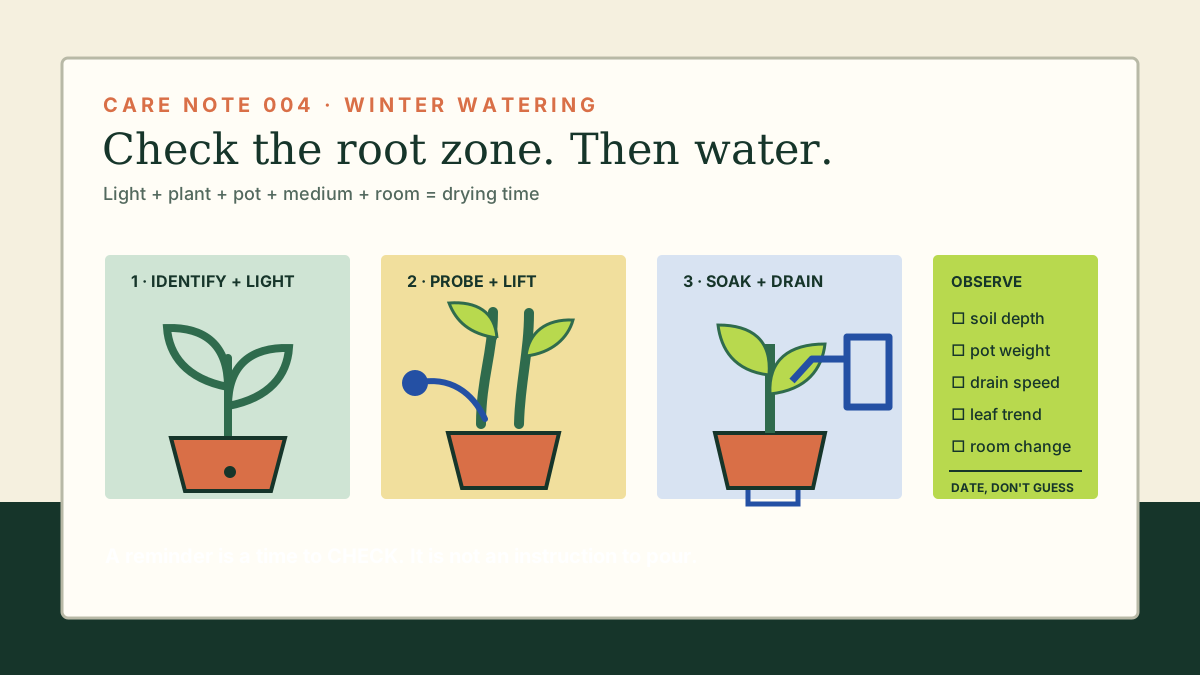
“Water weekly” sounds reassuring because it is easy to remember. It leaves out the variables that determine whether roots have water and oxygen: species, active growth, light, temperature, humidity, root mass, pot size, pot material, drainage and the structure of the potting medium. Those variables change after a plant moves indoors, after the heat turns on, and whenever a grow light or humidifier changes the room.
The result is a familiar loop. A drooping or yellowing plant gets more water because it looks thirsty. If the root zone was already wet, that response extends the saturation. Damaged roots then absorb less water, and the foliage can keep wilting. The leaf symptom did not name the cause.
A better routine has two separate events: check and water. Put the check on a calendar. Let the plant’s documented moisture range and the actual root zone decide whether watering happens.
Why the same winter interval does not fit every pot
Indoor light often falls in autumn and winter. Penn State Extension notes that houseplants brought indoors commonly grow more slowly in lower light and therefore need less water; its guidance is to use soil moisture rather than the former outdoor schedule. That is a useful seasonal direction, not a universal instruction to stretch every interval by the same number of days.
A plant kept under a measured grow light may remain active. A plant beside a forced-air register may dry quickly at the foliage and pot surface. A large plant may have filled most of its pot with roots, leaving less medium to hold water. A recently upsized plant can sit in a much larger volume of wet mix. Plastic and glazed containers tend to lose less water through their walls than unglazed clay. Two matching plants can therefore reach the next watering day at different times.
| Factor | Faster drying is more likely when | Slower drying is more likely when | What to record |
|---|---|---|---|
| Light and growth | Light is stronger and new growth is active | Light is lower and growth has slowed | Window or fixture, hours, new growth |
| Plant and roots | Foliage and roots are large for the pot | Roots are sparse, damaged or recently disturbed | Plant name, root condition, last repot |
| Container | Pot is small, porous or exposed | Pot is large, nonporous or inside a cachepot | Diameter, material, drainage holes |
| Medium | Particles are coarse and air spaces remain open | Mix is fine, compacted or broken down | Components, age, drain speed |
| Room | Air is warm, dry or moving | Room is cool, humid or still | Temperature, humidity, nearby drafts |
Use these factors to decide when to check more closely. They do not replace the moisture preference of an identified plant. A bird’s nest fern and a snake plant should not be pushed through the same dry-down target because they share a shelf.
Build a one-card baseline for each plant
Start with the correct botanical or reliable common identification. Record the moisture guidance from a university Extension profile, botanical garden, or other accountable source. Avoid translating “evenly moist,” “dry moderately,” and “dry fully” into one universal fingertip rule. The inspection depth and safe degree of drying depend on the root system and species.
- Plant: accepted name and any cultivar-specific care.
- Current light: window direction and distance, or grow-light model, distance and timer.
- Pot: diameter, depth, material and working drainage holes.
- Medium: known components, approximate age and whether water penetrates evenly.
- Moisture target: the documented condition that starts watering.
- Last watered: date, method, drain behavior and anything unusual.
- Current trend: new growth, leaf changes, pests, temperature or room move.
This card is not a promise that the plant will need water after a certain number of days. It helps you notice when the interval changes and ask why. A pot that once took ten days and is suddenly dry in four may be rootbound, sitting in stronger light, exposed to moving air or shedding water down a gap. A pot that stays wet twice as long may have lost light, entered slower growth, developed a blocked drain or be holding water in an outer cover.
Use more than one moisture clue
Probe the medium at a useful depth
Touching the surface is not enough for a deep pot. Insert a finger or clean wooden probe to the depth appropriate for the plant and container. Observe whether the medium feels cool and damp, clings to the probe, or is dry and loose. Do not repeatedly stab thick roots or use the same unclean probe across plants with possible disease or pests.
A low-cost wooden skewer can show moisture along more of the profile, but dark particles and fertilizer residues can confuse the reading. Read it together with pot weight, drainage history and the plant’s baseline. Do not leave a wooden probe embedded where it can rot or become a path for contamination.
Lift the pot
After a thorough watering and complete drainage, lift a manageable pot and learn its heavy state. Lift again as it dries. Weight integrates moisture from more of the root ball than a surface glance. Use a small platform scale for pots that are awkward but within the scale’s rating; never strain to lift a large container. Record the number if accessibility, memory or a large collection makes comparison hard.
Look at the drain pattern
Notice how quickly water enters, spreads and exits. Water that disappears immediately down the wall of the pot may be bypassing a root ball that has shrunk away from the container. Very slow drainage can point to compacted medium, blocked holes, a dense root mass, or a pot sitting flat against a sealed surface. Drain speed alone does not say “water more” or “water less”; it tells you to inspect the system.
Read the plant as a trend
Some species visibly soften, fold or lose gloss as water becomes limited. Learn the normal sign from a reliable profile and act before repeated severe wilting damages roots. Compare photographs under similar light. One yellow leaf on an older stem means less than yellowing that advances through the plant after a change in care.
Water when the root-zone check reaches the plant’s documented target and a second clue—such as pot weight or the known dry-down trend—agrees. If foliage says “thirsty” while the root zone says “wet,” stop and investigate.
When it is time, wet the root ball and let it drain
Move the plant to a place where drainage water can be handled, or protect the surface with a properly sized saucer. Apply room-temperature water slowly across the medium rather than pouring repeatedly into one channel. Pause as needed so a dry mix can absorb. Continue until the root ball is wetted and excess begins to leave the drainage holes, unless the plant’s authoritative care guidance specifies another method.
Let the container drain fully. Empty the saucer or decorative cachepot so the nursery pot is not standing in water. Check a deep cachepot by lifting the inner pot; water can remain hidden below it. Return the plant only after the outside of the pot and surface are safe for the shelf.
Iowa State Extension advises watering containers until water begins to flow from drainage holes. It also notes that a completely dry potting mix can shrink from the pot and become difficult to rewet because water runs around the root ball. For a badly dried, compatible container, gradual soaking may be needed to rehydrate the mix; confirm that approach for the plant and medium, use clean water, and drain completely afterward.
Top watering, bottom watering, and self-watering are systems
Top watering makes it easier to observe infiltration and flush some accumulated soluble salts through a drained pot. Bottom watering can rewet a hydrophobic root ball more evenly when the plant, pot and medium suit the method, but the pot must come out of the water and drain. It does not eliminate the need to monitor the upper root zone or manage salt buildup.
A self-watering planter uses a reservoir and wicking design. Its success depends on a medium that can move water, roots adapted to the system, clean components and a refill practice that follows the maker’s instructions. It is not simply a cachepot kept full. Do not convert a plant during stress without identifying whether its roots and medium fit that system.
Do not diagnose wet versus dry from one leaf
Wilting, yellowing, browning and leaf loss can occur on both sides of the watering problem. Iowa State Extension explains that roots kept wet for long periods can rot; compromised roots then cannot take up water, so an overwatered plant may wilt. Drought can also injure roots, and a large emergency pour does not instantly rebuild them.
| What you see | What to check before acting | Avoid |
|---|---|---|
| Wilt with wet medium | Drainage, root smell and color, pot size, compacted mix, cold exposure | Adding more water because leaves droop |
| Wilt with dry medium | Depth of dryness, hydrophobic gaps, root condition, heat or light change | Repeated shallow sips that miss the root ball |
| Yellow leaves | Which leaves, moisture history, light, pests, nutrition, natural aging | Fertilizing or watering from color alone |
| Brown tips | Drying pattern, soluble salts, humidity, water quality, root health | Assuming every brown edge means low humidity |
| Fungus gnats | Persistently moist surface, decaying material, drainage and watering frequency | Treating adults while keeping the medium continuously wet |
If roots are soft, dark, foul-smelling or sloughing, separate the plant and use a reliable diagnostic source. Do not reuse suspect potting mix or move contaminated water between pots. Clean tools and containers appropriately. A valuable or rapidly declining specimen may need help from a local Extension service, plant clinic or experienced horticulturist.
Adjust through winter without declaring every plant dormant
Many houseplants slow when natural light declines, but a plant in warm conditions under adequate measured light may keep growing. Winter does not automatically mean “half as much water” or “no fertilizer.” It means the environment has changed and the plant should be observed again.
- When the heat starts: check temperature, humidity and direct airflow at plant height. Move leaves out of hot drafts.
- When days shorten: reassess window light and clean foliage and glazing. Use the measured grow-light guide if supplemental light is appropriate.
- After bringing plants inside: keep them isolated, monitor pests, and replace the outdoor watering rhythm with indoor checks using the fall transition sequence.
- After a room move: shorten the observation interval until a new dry-down pattern is clear.
- During active growth: follow species-specific nutrition guidance and the fertilizer label. Do not use fertilizer to correct a watering or root problem.
Humidity and pot moisture are different measurements. Misting leaves briefly does not reliably keep the root zone watered and, as Penn State Extension notes, common humidity tactics do not all produce the claimed result. Use a hygrometer when humidity matters, match the target to the plant and building, and manage root-zone moisture separately.
Choose tools by the question they answer
A future product brief should state the measurement, operating range, cleaning needs and limits. “Prevents overwatering” is too broad for a meter, pot or app. No tool knows the species, root health and growing system unless a person supplies that context.
- Long-spout watering can: improves placement and control; it does not decide when to water.
- Wood probe: offers a simple depth clue; replace it and keep it clean.
- Platform scale: makes pot-weight trends visible; use within its rating on a stable surface.
- Moisture meter: gives a local reading influenced by medium composition, salts, contact and calibration. Read and test its instructions; do not treat one number as a diagnosis.
- Saucer or tray: protects surfaces and catches drainage; size it so it can be emptied without spills.
- Reminder app or notebook: schedules checks and records changes. The alert is never automatic permission to water.
Before any purchase, test what observation is currently missing. A finger, pot lift and dated card may answer the question. A tool earns space when it makes a specific check safer, more accessible, more consistent or easier to record.
A 15-minute winter watering round
- Scan every plant for change before moving anything.
- Check the room temperature, nearby airflow and any change in light.
- Read each plant’s moisture target from its card.
- Probe the root zone at the appropriate depth and lift or weigh the pot.
- Set aside only the plants whose checks agree that watering is due.
- Water each root ball evenly, observe penetration and let it drain.
- Empty saucers and cachepots; wipe spills and return plants safely.
- Record the date, unusual drain behavior and the next check day.
- Isolate any plant with unexplained decline, pests or suspected root trouble.
Over several rounds, the record becomes more useful than a generic schedule. It shows which plants dry together, which need an earlier check, and which pot or medium makes care unnecessarily difficult. Change one factor at a time so you can tell whether it helped.
Questions the schedule cannot answer
How often should I water in winter?
Set a check interval, not a fixed watering interval. Inspect more often than you expect to water until you understand the new indoor pattern. The actual watering date comes from the plant’s documented moisture target and the root-zone evidence.
Should I water all plants on the same day?
You can inspect them together. Water only those that are ready. Grouping plants with similar needs, light, potting medium and pot size can make the round easier, but each container still needs a check.
Does a drainage hole make overwatering impossible?
No. A drainage hole lets excess water leave, but watering too frequently can keep the lower medium saturated. Blocked holes, dense mix, oversized pots and water trapped in a cachepot can still reduce root-zone oxygen.
Should I repot a plant that stays wet?
First check light, temperature, pot size, drain holes, cachepot water, medium condition and root health. Repot when the container, degraded medium or roots justify it. Unnecessary repotting adds stress and can obscure the original problem.